Please review this checklist and testing schedule BEFORE arriving for your test.
If any of these conditions are not met, the CARB system will automatically reject the compliance report.
1. TECHNICAL CHECKLIST: LIGHTS, READY STATUS & TEMPERATURE
A. CHECK ENGINE LIGHT (MIL)
Key On, Engine Off: The Check Engine light MUST turn on when you turn the key (Bulb Check). If it does not light up, it is an automatic failure.
Engine Running: The Check Engine light MUST turn OFF.
⚠️ IMPORTANT VOLVO NOTE: If your truck is a Volvo and the Check Engine light stays ON, the test might still pass IF the fault code is not related to emissions (e.g., coolant level sensor or water-in-fuel sensor). However, if the code is emissions-related (NOx sensors, DPF, SCR/DEF system), the truck will fail. Please have your dispatcher or mechanic check the specific fault codes before arrival.
B. ENGINE TEMPERATURE
The engine temperature MUST be at least 150°F at the start of the inspection. Do NOT shut off the engine during the test procedure, as it will interrupt the data upload and fail the test.
C. "READY" STATUS (MONITORS)
If you recently cleared fault codes or replaced/disconnected the batteries/accumulator, the truck's computer will be "Not Ready." To pass the test, you MUST meet ALL of the following conditions simultaneously:
Mileage: At least 200 miles of actual road driving.
Engine Run Time: At least 400 minutes of total engine operation.
Warm-up Cycles: At least 5 full warm-up cycles (letting the engine warm up from a cold start to full operating temperature).
CRITICAL: Idling the truck for 400 minutes will NOT work! The computer needs real driving under load to run its internal emission monitors.
2. CARB REGISTRATION & COMPLIANCE FEE
Check with your company's office or your dispatcher to confirm:
Is your truck's VIN officially registered in the CARB CTC-VIS system?
Has the $32.13 Compliance Fee (for 2026) been paid to the state?
Note: If the office has not completed the registration or paid this fee, your truck will remain "Non-Compliant" in the CARB database even if it passes the technical OBD test perfectly.
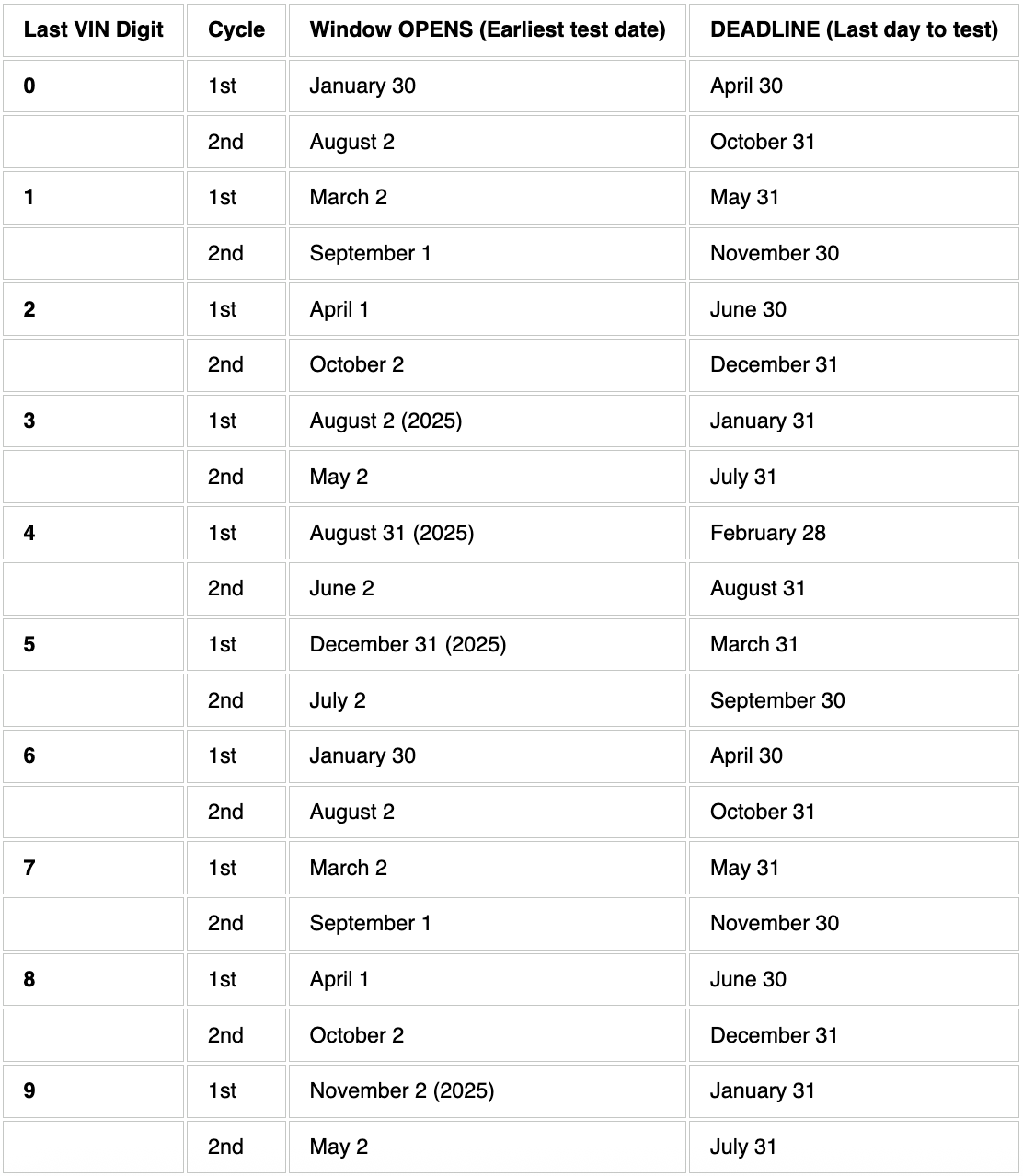
3. OFFICIAL 2026 TESTING SCHEDULE (BY LAST DIGIT OF VIN)
CARB Clean Truck Check requires two periodic tests per year (except for motorhomes/agricultural vehicles). Find your deadline using the last digit of your truck's VIN:
CRITICAL INSTRUCTIONS FOR TIMING YOUR TEST
Do Not Test Early: The compliance testing window opens exactly 90 days before your deadline. If you submit a test on the 91st day (even one day before the window officially opens), the CARB system will not accept it as a periodic test. Always verify your opening date in the table above.
Pay the Fee First: It is highly recommended that the fleet office pays the annual $32.13 compliance fee before the inspector hooks up the scanner. This guarantees that your truck’s status updates to "Compliant" immediately after the OBD data is uploaded.
Always Verify in CTC-VIS: While this table represents the standard legal schedule, your individual CTC-VIS portal account is the ultimate authority. If your truck has a history of out-of-state transfers or specific CA registration dates, your exact deadline might differ slightly. Always cross-check the date listed in your online fleet account.
INSPECTION SERVICE & DISCLAIMER
Certified Testing: This test is performed by a CARB-credentialed and certified tester utilizing official diagnostic equipment compliant with California Clean Truck Check regulations.
Inspection Fee: The fee for the testing and submission service is $150 (per truck, per test cycle). This fee covers the inspection process and data transmission to the state database.
Limitation of Liability: The inspector performs a high-quality, objective evaluation of the vehicle’s readiness to operate legally within the state of California based on the real-time data provided by the truck's On-Board Diagnostics (OBD) system. The tester is not responsible for the pass/fail results generated by the truck's internal computers, nor for any pre-existing mechanical, electronic, or compliance-related issues that may prevent successful state approval.